
11/11/2026
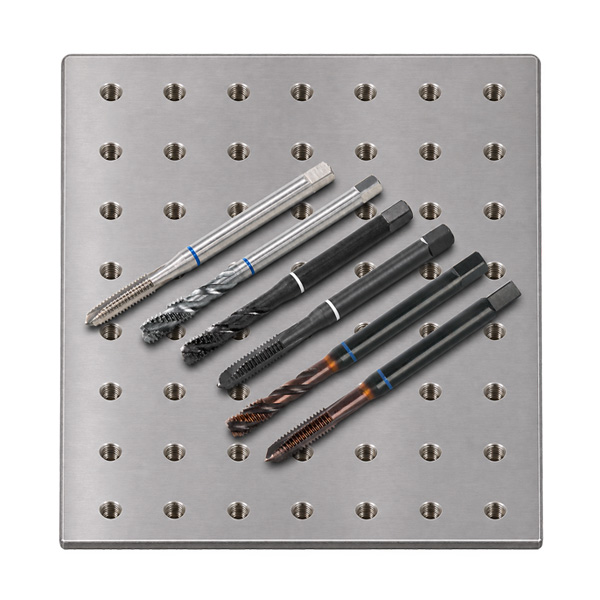
Tapping Stainless Steel
What should be considered when tapping stainless steel?
When tapping stainless steel, the steel grade, thread type and machining method determine the choice of tool. The following guide explains the material designations and shows what needs to be considered when producing internal threads.
What stainless steel is and where it is used
Stainless steel is a collective term for different groups of steel, including corrosion-resistant steels. However, the term stainless steel alone does not mean that the steel is completely “rust-free”. The following section focuses on corrosion-resistant stainless steels, also referred to as VA or INOX.
Stainless steels contain at least 10.5% chromium and no more than 1.2% carbon by mass. The chromium enables a very thin protective passive layer to form on the surface. This gives the material its corrosion resistance. How resistant a particular grade is also depends on the other alloying elements and the conditions in which it is used.
Typical areas of application include mechanical and plant engineering, the food and beverage industry, chemical and pharmaceutical engineering and construction. Stainless steels are used, for example, for vessels, pipework, valves and fittings, kitchen equipment and railings. Depending on the application, corrosion resistance, easy-to-clean surfaces or a permanently attractive appearance may be the main priority.
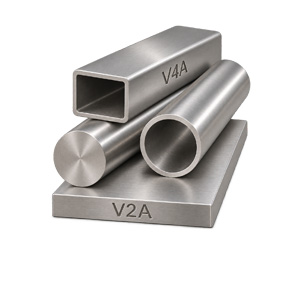
Distinguishing V2A and V4A by material number
V2A and V4A are historical collective designations. V2A generally refers to chromium-nickel steels, while V4A refers to chromium-nickel-molybdenum steels. The additional molybdenum improves resistance to corrosion, particularly corrosion that can be caused, for example, by salt water, chlorides and acids. However, these two designations do not define one specific steel grade. Many common V2A and V4A grades are austenitic. This describes their metallurgical structure, i.e. the internal structure of the material.
A material number such as 1.4301 identifies a specific steel grade with a defined chemical composition. The number is neither a hardness specification nor a ranking of material quality. The material number is a standardised, unambiguous designation for technical materials used for reliable identification. It consists of a main group digit, separated by a decimal point from the four-digit grade number. The main group indicates the principal material group (for example, 1 for steels). The following grade number identifies the exact material grade within the main group and includes, among other things, characteristics such as the alloy type (chemical composition of the material). For tool selection, the exact material number should therefore be available, for example from the material certificate.
The following table provides an overview of common grades and designations.
| Material | AISI | Common designation | Notes for tapping |
|---|---|---|---|
| 1.4301 - X5CrNi18-10 | 304 | commonly V2A | Austenitic, tough and prone to work hardening; effective cutting action and lubrication are important |
| 1.4305 - X8CrNiS18-9 | 303 | Free-machining stainless steel | The addition of sulphur makes it considerably easier to machine than typical standard austenitic grades |
| 1.4306 / 1.4307 | 304L | commonly V2A | Low-carbon austenitic grade; still prone to work hardening |
| 1.4541 - X6CrNiTi18-10 | 321 | commonly V2A | Titanium-stabilised austenitic stainless steel; tooling and cutting conditions should be adjusted accordingly |
| 1.4401 - X5CrNiMo17-12-2 | 316 | commonly V4A | Molybdenum-alloyed austenitic stainless steel with tough chip formation |
| 1.4404 - X2CrNiMo17-12-2 | 316L | commonly V4A | Low-carbon molybdenum-alloyed grade; prone to work hardening and comparatively difficult to machine |
Why tapping stainless steels is more demanding
Common austenitic grades are often more difficult to machine than unalloyed steels. When tapping, three properties are particularly relevant:
Work hardening: Plastic deformation can increase the strength of the material at the machining point. A blunt cutting edge that rubs heavily can therefore make the subsequent cut more difficult.
Tough chip formation: Chips are often difficult to break. If they cannot move freely within the restricted working area of the tap, the load on the tool increases.
Low thermal conductivity: Compared with unalloyed steels, heat is dissipated less effectively from the cutting zone. Together with the tendency for material to adhere to the tool, this places additional strain on the cutting edges.
The condition of the workpiece as supplied also influences machinability: cold-worked semi-finished material can behave differently during machining from the same steel grade in the annealed condition. The preparatory drilling should therefore be carried out with a sharp, suitable drill and appropriate cutting conditions. Prolonged rubbing without effective material removal should be avoided.
Selecting suitable threading tools
For the machine production of internal threads in stainless steel, two tool types from the VÖLKEL range of coloured ring machine taps are particularly suitable.
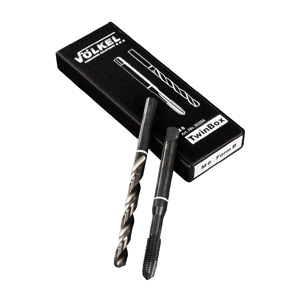
VÖLKEL WHITE RING machine taps for V2A stainless steels
These machine taps are particularly suitable for long-chipping V2A stainless steels and high-alloy chromium steels with tensile strengths of up to 1,000 N/mm². The machine taps are made from high-quality HSSE steel, their cutting geometry has been optimised for machining V2A stainless steels and their surface is additionally steam tempered.
What does the steam-tempered surface do?
During steam tempering - often identified as VAP - the tool surface is modified by heat treatment. This produces an iron oxide layer with a surface structure to which coolants and lubricants can adhere more effectively.
When tapping stainless steel, this effect is particularly helpful. The lubricating film reduces direct contact between the tool and workpiece, improves sliding conditions and reduces the risk of cold welding. This occurs when particles of the workpiece material adhere to the cutting edges under high load and can subsequently affect both the tool and the thread flanks.
⚠️ VAP does not replace the cutting fluid. The surface treatment supports its effect - sufficient lubrication suitable for the material and machining operation remains essential.
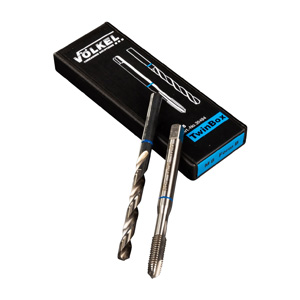
VÖLKEL BLUE RING machine taps for V4A stainless steels
V4A comprises stainless steel grades that are difficult to machine. During tapping, they generally produce tough chips that are difficult to break, which can be particularly problematic in blind holes. The properties of the BLUE RING machine taps, such as their cutting geometry, have also been optimised so that threads can be cut in wear-resistant steels and high-alloy steels with tensile strengths of up to 1,200 N/mm².
Why can an additional TiCN coating be beneficial?
A TiCN coating (titanium carbonitride) forms a thin, hard protective layer on the tap. When tapping, its main benefit is to reduce wear on the cutting edges through improved hardness and toughness, thereby extending tool life. At 3,000 HV (Vickers hardness), the TiCN coating is harder than a pure TiN coating.
⚠️ TiCN has lower heat resistance. Intensive and optimum cooling of the tap's cutting edges is essential during the cutting process. This reduces the risk of cutting-edge chipping.
What other factors should be considered when tapping stainless steel?
1. Use of cutting lubricant and its correct application
A cutting fluid suitable for stainless steel must reliably reach the cutting zone and the cutting edges of the tap must not be allowed to “run dry”. All lubricants offered by VÖLKEL are suitable for machining stainless steels. The choice depends on the specific application.
2. Set the correct tapping drill diameter
A tapping hole that is too small increases the chip volume and torque and therefore increases the load on the tool. A moderate increase in the tapping drill diameter can reduce the torque and improve tap life. However, this does not mean that the tapping hole can be enlarged arbitrarily: the drawing, thread tolerance, load-carrying capacity, tool specifications and inspection requirements remain decisive.
If the tapping hole is too large, however, the thread profile is not formed sufficiently, reducing the load-carrying capacity of the cut thread. The specifications for thread size, pitch and tolerance, together with the actual drilled-hole diameter, are therefore decisive.
3. Select the correct drilling depth for blind holes
Usable thread depth and tapping-drill depth are different dimensions. With blind holes, additional space must be provided below the usable thread.
Allowance must be made for at least the tap chamfer, drill point, safety clearance and chip space. If the hole is drilled only to the required thread depth, the tap can bottom out against the base of the hole or against compacted chips. This can cause the tap to break. Taps for blind holes generally have a short chamfer (2-3 threads) and a spiral flute that carries the chips upwards and out of the hole.
⚠️ Whether a tap has a flat end or a point does not determine whether it is a blind-hole tap. For manufacturing reasons, many taps ≤ M 8 may therefore have a point.
4. Match spindle speed and feed to the tool
Guideline for VA steels below 850 N/mm² and for the V4A material group when tapping with VÖLKEL WHITE RING machine taps: 2–4 m/min - this figure is not a general recommendation for all stainless steel threading tools. The setting must be matched to the material condition, thread depth and machine conditions.
The spindle speed is calculated from the cutting speed and the nominal thread diameter:
n = 1,000 × vc π × d
Here, n is the spindle speed in min⁻¹, vc is the cutting speed in m/min and d is the nominal thread diameter in mm.
Example for M8: At vc = 3 m/min and d = 8 mm, the result is approximately 119 min⁻¹. When synchronously machine tapping an M8 × 1.25 thread, the axial feed is 1.25 mm per revolution. With the spindle speed rounded to 120 min⁻¹, this corresponds to 150 mm/min. The machine cycle and toolholder used must be suitable for these values; the specifications for compensating tap holders must be observed separately.
Why can taps break when tapping stainless steel?
When tapping an internal thread, several cutting edges are engaged simultaneously within a relatively confined hole. Errors in hole preparation or chip evacuation can therefore quickly result in high tapping torque. Typical causes of problems include:
- Wrong tap type for the hole type: The chips are not evacuated in the required direction.
- Tapping hole too small: The chip volume and therefore the cutting forces and tapping torque increase.
- Poor alignment: The tap is subjected to lateral loading.
- Insufficient lubrication: Friction and the risk of cold welding increase.
- Chip accumulation: Particularly in blind holes, the available chip space can become overloaded.
- Worn cutting edges: The tool cuts less cleanly and places greater stress on the workpiece material.
- Work hardening: Rubbing, repeated starting or interrupted machining can make the subsequent cut more difficult.
When tapping stainless steel, it is therefore worth checking the tapping hole, tap geometry, thread depth and chip space before making the first cut.
VÖLKEL machine taps for stainless steel: versions and sizes
The following tables make it easier to select the appropriate tool by thread type, tool version and hole type. Form B versions are listed for through holes, while Form C versions with a 39° right-hand spiral flute are listed for blind holes. The linked size ranges lead directly to the relevant product page with variant selection or to the corresponding set.
Suitability for your application depends on the exact steel grade, its condition as supplied and the machining conditions. You should also check the thread size, pitch, required thread depth and the dimensions of the toolholder.
Available VÖLKEL WHITE RING machine taps and sets
The WHITE RING range includes steam-tempered HSSE machine taps for metric coarse and fine threads as well as UNC, UNF and G (BSP) threads. In addition to individual machine taps, TwinBox combinations with a matching twist drill and machine tap sets are available.
| Thread type | Version | Through hole Form B | Blind hole Form C, 39° right-hand spiral flute |
|---|---|---|---|
| Metric ISO coarse thread (M) | DIN 371 / DIN 376 | M 3 - M 42 | M 3 - M 42 |
| Metric ISO fine thread (MF) | DIN 374 | M 5 × 0.5 - M 20 × 1.5 | M 5 × 0.5 - M 20 × 1.5 |
| Unified Coarse thread (UNC) | DIN 371 | UNC 1/4 - UNC 1/2 | UNC 1/4 - UNC 1/2 |
| Unified Fine thread (UNF) | DIN 371 | UNF 1/4 - UNF 1/2 | UNF 1/4 - UNF 1/2 |
| G (BSP) parallel pipe thread | DIN 5156 | G 1/8 - G 1/2 | G 1/8 - G 1/2 |
| Metric ISO coarse thread (M) | TwinBox: machine tap with matching twist drill | M 3 - M 16 | M 3 - M 16 |
| Metric ISO coarse thread (M) | 7-piece machine tap set, DIN 371 / DIN 376 | M 3 - M 12 | M 3 - M 12 |
| Metric ISO coarse thread (M) | 14-piece machine tap set including twist drills, DIN 371 / DIN 376 | M 3 - M 12 | M 3 - M 12 |
The four WHITE RING machine tap sets each contain the thread sizes M 3, M 4, M 5, M 6, M 8, M 10 and M 12. The 14-piece sets additionally contain the seven matching twist drills.
Available VÖLKEL BLUE RING machine taps and sets
The BLUE RING range includes metric machine taps in uncoated HSSE, with a TiCN coating and as HSSE High Performance MBlue machine taps. The table distinguishes explicitly between these versions because their available size ranges differ. TwinBox combinations and various machine tap sets are also available.
| Thread type | Version | Through hole Form B | Blind hole Form C, 39° right-hand spiral flute |
|---|---|---|---|
| Metric ISO coarse thread (M) | HSSE, uncoated, DIN 371 / DIN 376 | M 3 - M 42 | M 3 - M 42 |
| Metric ISO coarse thread (M) | HSSE with TiCN coating, DIN 371 / DIN 376 | M 3 - M 20 | M 3 - M 20 |
| Metric ISO coarse thread (M) | HSSE High Performance MBlue machine tap | M 3 - M 20 | M 3 - M 20 |
| Metric ISO coarse thread (M) | TwinBox: HSSE machine tap with matching twist drill | M 3 - M 16 | M 3 - M 16 |
| Metric ISO coarse thread (M) | 7-piece machine tap set, HSSE, DIN 371 / DIN 376 | M 3 - M 12 | M 3 - M 12 |
| Metric ISO coarse thread (M) | 7-piece machine tap set, HSSE TiCN, DIN 371 / DIN 376 | M 3 - M 12 | M 3 - M 12 |
| Metric ISO coarse thread (M) | 14-piece machine tap set, HSSE, including twist drills, DIN 371 / DIN 376 | M 3 - M 12 | M 3 - M 12 |
The six BLUE RING machine tap sets each contain the thread sizes M 3, M 4, M 5, M 6, M 8, M 10 and M 12. The 14-piece sets additionally contain the seven matching twist drills.
The size ranges in both tables indicate the smallest and largest available dimensions within the respective product range or set. The individual thread sizes, pitches, tool dimensions and delivery times can be found on the respective linked product page.
