
01/09/2026
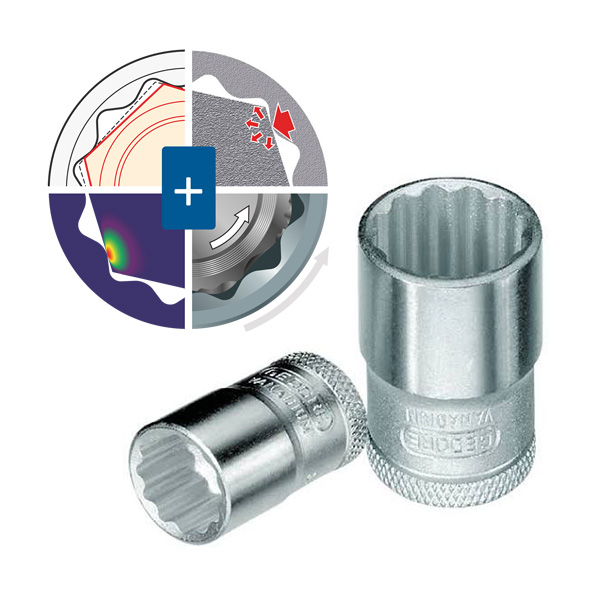
GEDORE Tools with UD Profile
What is the GEDORE UNIT-DRIVE profile?
The GEDORE UNIT-DRIVE profile (UD profile) is a specially shaped tool profile for screw heads and nuts. It is characterised by its wave-shaped geometry with enlarged, rounded contact surfaces. Instead of concentrating force locally, particularly on the vulnerable corners of the screw head profile, the tool makes contact over a larger area of the flanks. This distributes the load more evenly when tightening and loosening. It reduces stress on the screw head profile and supports secure tool contact, particularly where a screw connection has already been tightened and loosened repeatedly or the screw head is showing initial signs of wear.
Optimum force transmission protects screw heads
Force transmission is determined not only by the applied torque, but also by the area over which the tool and screw head are in contact. Small or poorly positioned contact surfaces produce high localised loads. A direct comparison between a conventional tool profile and the GEDORE UNIT-DRIVE profile shows how the different contact surfaces affect force transmission, the notch effect and the load on the screw head.
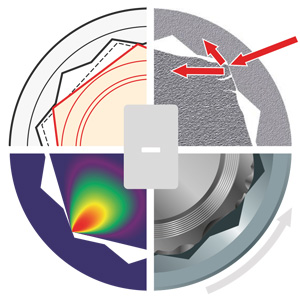
Conventional profile: high localised load on the edges
- Smaller contact surfaces concentrate the forces on a limited area of the screw head.
- Sharply defined contact zones increase the notch effect and can place greater stress on the screw head profile.
- Screw heads with already worn or rounded profile edges can become difficult or impossible to loosen – the tool may slip under load.
- High localised loading at the profile corners can further deform the screw head and make later removal more difficult.
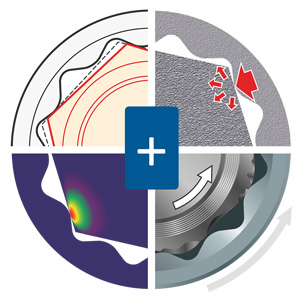
GEDORE UNIT-DRIVE: larger contact surfaces on the flanks
- Enlarged contact surfaces support secure force transmission, even on screw heads or nuts whose dimensions are outside tolerance or whose profile edges are already rounded.
- The force is distributed more evenly across the flanks of the screw head. This reduces the load on the vulnerable profile corners and decreases the notch effect.
- Even on already worn screw heads or nuts, the profile geometry supports secure tool contact and makes loosening easier through more even and gentle torque transmission.
- The optimised force distribution allows up to 20% more torque to be transmitted.
When is the UD profile particularly useful in practice?
The GEDORE UD profile is particularly beneficial for work where screw connections are regularly loosened and reassembled. Typical applications therefore include workshop and assembly work as well as servicing and maintenance of machinery, equipment or vehicles. In these situations, it is often important to minimise damage to screws and nuts during repeated use and to keep the profile usable for subsequent work.
For the user, the benefit therefore lies not only in secure force transmission. It is equally important to avoid consequential damage to the screw head and additional work wherever possible. If the screw profile remains in better condition, there is less risk of requiring additional loosening or extraction tools during later removal. This can simplify work processes and help avoid unnecessary repairs or downtime.
Can the UD profile also help with worn screw heads?
Yes – provided that enough usable profile surface remains on the screw head. This is precisely where an important difference from purely localised force transmission becomes apparent. The larger contact surface supports secure force transmission even on screw heads and nuts whose dimensions are outside tolerance or which are already worn.
However, this does not make the UD profile a universal extractor for every badly damaged screw. If hardly any usable surface of the original profile remains, even an optimised tool profile can no longer provide sufficient force transmission. Special loosening or extraction tools may therefore still be required for badly damaged screw connections.
For removing broken or damaged screws:GEDORE screw extractors (left-hand extractors)
For splitting seized, damaged, rusted or rounded nuts:GEDORE nut splitters
What does “up to 20% more torque” mean with the UD profile?
Thanks to the optimised force distribution of the GEDORE UNIT-DRIVE profile, up to 20% more torque can be transmitted. This refers to torque transmission between the tool and the screw head or nut: the larger contact surfaces allow the torque to be transferred into the screw connection more effectively.
However, this does not mean that a screw may be tightened with a 20% higher tightening torque. For specified screw connections, the tightening torque prescribed for the screw, component and application always remains decisive. The UD profile improves torque transmission – it does not change the permitted tightening torque of the screw connection.
Which tools does GEDORE offer with the UNIT-DRIVE profile?
GEDORE offers a range of spanners and sockets in metric and imperial sizes with the UD profile. In addition, various GEDORE ratchet sets, socket sets and spanner sets contain tools with the UNIT-DRIVE profile.
⚠️ When selecting products in our shop, look for the designation UNIT-DRIVE, UD profile or the following symbol: 
GEDORE spanners
Combination spannersRatchet spannersDouble-ended ring spannersRing slogging spannersFlex-head spannersConstruction ratchetsFreewheel ratchets
GEDORE sockets
| Square drive | GEDORE version | Metric | Imperial (AF) |
|---|---|---|---|
| 1/4" (6.3 mm) | D 20 socket, short | 4–14 mm | 3/16"–9/16" AF |
| 1/4" (6.3 mm) | D 20 L socket, long | – | 3/16"–1/2" AF |
| 3/8" (10 mm) | D 30 socket, short | 6–24 mm | 1/4"–1" AF |
| 3/8" (10 mm) | D 30 L socket, long | 10–22 mm | – |
| 1/2" (12.5 mm) | D 19 socket, short | 8–36 mm | 5/16"–1 1/4" AF |
| 1/2" (12.5 mm) | D 19 L socket, long | 10–34 mm | 1/2"–15/16" AF |
| 3/4" (20 mm) | D 32 socket, short | 19–60 mm | 7/8"–2" AF |
| 1" (25 mm) | D 21 socket, short | 36–80 mm | 1.1/2"–3.1/8" AF |
